Unlocking Claude Code: Your Complete Guide to Mastery
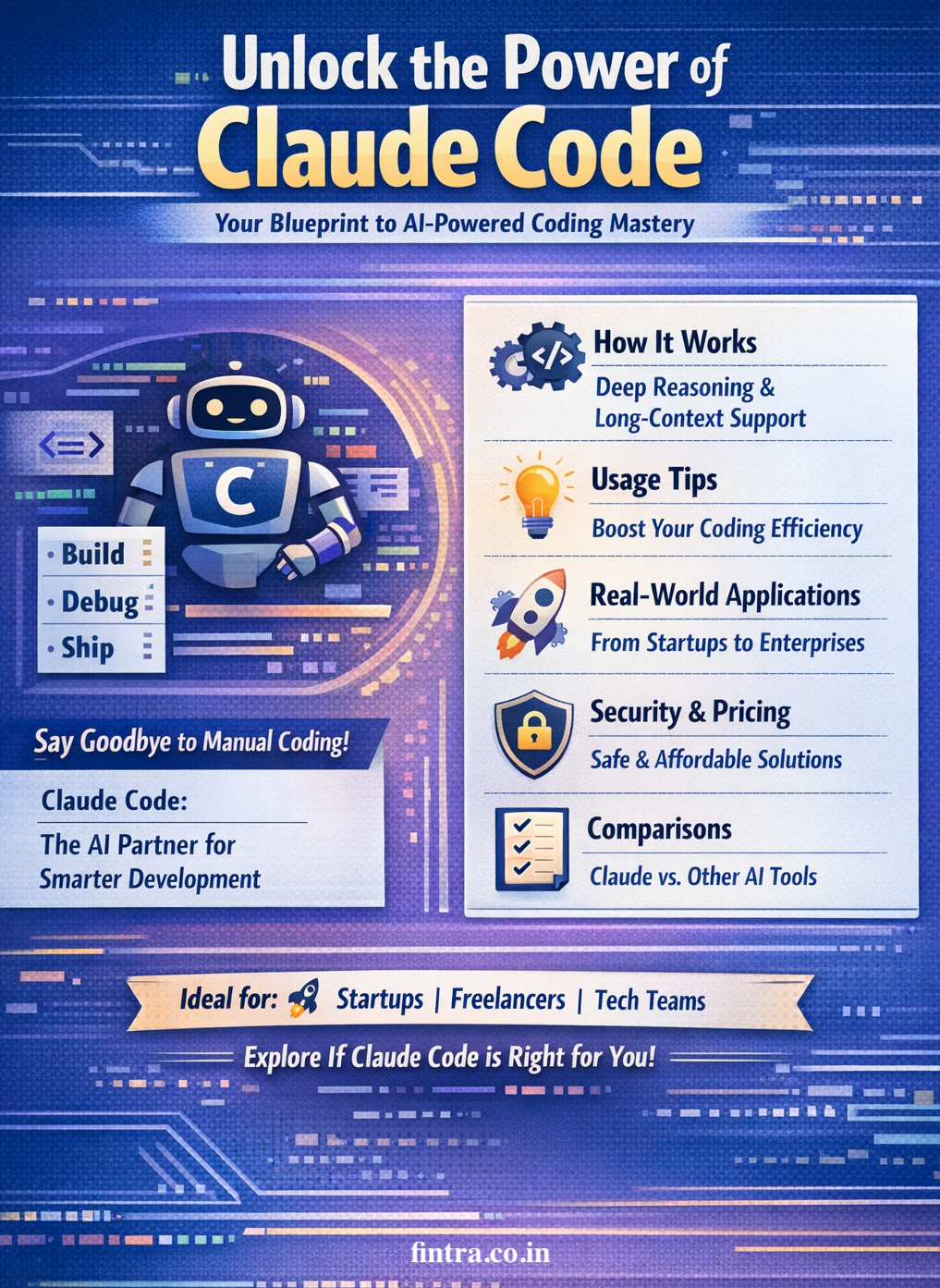
The era of writing boilerplate by hand is over. To stay ahead of the curve, one needs to unlock the power of Claude Code. As the premier AI coding assistant developed by Anthropic, this tool is redefining how developers build, debug, and ship production-grade software. Whether you are looking for essential tips or deep insights into mastering Claude, this guide is your blueprint. We will explore how Claude Code leverages deep reasoning to handle massive codebases, making it the ultimate partner for leveling up your coding skills and accelerating your roadmap.
Developers are making the switch because AI-powered coding tools are no longer a luxury; they are a necessity. However, Claude Code stands apart from standard auto-complete bots. It is engineered for complex logic, offering long-context support that allows it to understand your entire project structure, not just the file you have open.
In this in-depth guide, Fintra will cover everything about Claude Code. For example, we will highlight how it works, usage tips, real-world applications, pricing, security, and tool comparisons. Its deep reasoning, long context support, and security-first design make Claude Code ideal for startups, freelancers, and enterprise tech teams. Whether you’re new to coding or an industry veteran, this guide will help you determine if Claude Code fits your needs.
The Importance of Learning Claude Code
Learning Claude Code is an invaluable skill in today's technological landscape. As a powerful programming language, it offers a unique blend of simplicity and robustness, making it suitable for novice and experienced developers. Designed to be highly readable and easy to understand, Claude Code allows developers to write clean and efficient code with minimal effort. In short, mastering Claude Code opens up a world of opportunities, from developing advanced software solutions to automating complex tasks.
Moving on, Claude Code's versatility makes it an ideal choice for a wide range of applications. Whether you're interested in web development, data analysis, artificial intelligence, or system automation, Claude Code furnishes the tools and frameworks necessary to bring your ideas to life. Its extensive library ecosystem and strong community support further enhance its appeal, offering a wealth of resources and pre-built functionalities to streamline your development process. By investing time in learning Claude Code, you're not only enhancing your coding skills but also positioning yourself for success in a rapidly evolving tech industry.
Mastering Claude Code even boosts career prospects. This is so because as demand rises for professionals skilled in this field, a strong command of Claude Code sets one apart. Whether advancing your career, changing fields, or starting a venture, learning Claude Code unlocks new opportunities for success.
Key Features of Claude Code
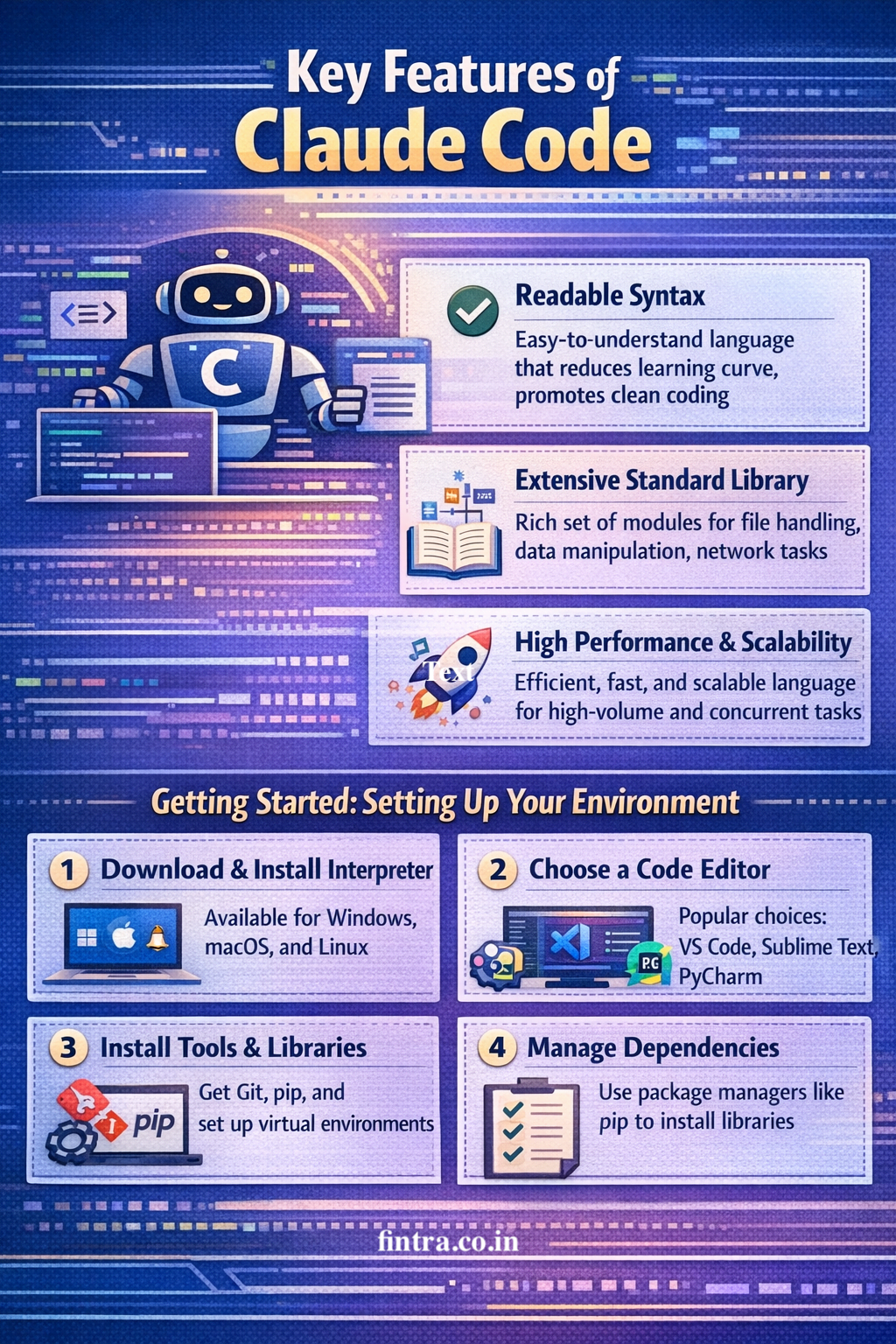
Claude Code stands out for its intuitive design and powerful features, which cater to both beginners and seasoned developers. One of its most notable features is its readability. The language's syntax is designed to be straightforward and easy to understand, reducing the learning curve for new programmers. This emphasis on readability not only makes Claude Code accessible but also promotes best practices in coding, such as writing clean and maintainable code.
Another key feature of Claude Code is its extensive standard library. This library encompasses a diverse range of modules and functions that streamline common programming tasks, including file handling, data manipulation, and network communication. By leveraging these built-in capabilities, developers can save time and effort, focusing on the core logic of their applications rather than reinventing the wheel. Additionally, the standard library is well-documented, providing clear and comprehensive guidance on how to use its various components effectively.
Claude Code also excels in terms of performance and scalability. The language is designed to be efficient and fast, making it suitable for high-performance applications. Its support for multithreading and asynchronous programming allows developers to build responsive and scalable systems that can handle large volumes of data and concurrent tasks. Furthermore, Claude Code's compatibility with various platforms and operating systems ensures that your applications can run seamlessly across different environments, enhancing their versatility and reach.
Getting Started: Setting Up Your Environment
Before you can start coding in Claude Code, you need to set up your development environment. The first step is to download and install the Claude Code interpreter, which is available for all major operating systems, including Windows, macOS, and Linux. You can find the latest version of the interpreter on the official Claude Code website, along with detailed installation instructions. Once the interpreter is installed, you can verify the installation by running a simple command in your terminal or command prompt to check the version number.
In addition to the interpreter, you'll need a suitable code editor or integrated development environment (IDE) to write and manage your code. There are several popular options to choose from. These editors offer features like syntax highlighting, code completion, and debugging tools, which can enhance your coding experience and productivity. Take some time to explore the features of different editors and choose one that best meets your needs and preferences.
Once your editor is set up, consider installing additional tools and libraries that support your development process. For example, you may want to install version control software, such as Git, to manage your code repositories and collaborate with other developers. You can also explore package managers like pip, which allow you to easily install and manage third-party libraries and dependencies. Setting up a virtual environment is another recommended practice, as it helps isolate your project-specific dependencies and avoid conflicts with other projects.
Essential Syntax and Commands in Claude Code
Understanding the essential syntax and commands of Claude Code is crucial for writing effective programs. At its core, Claude Code uses a simple and consistent syntax that emphasizes readability and ease of use. For example, indentation is used to define the structure of the code, such as loops and conditionals, rather than relying on braces or keywords. This approach not only makes the code more visually appealing but also helps prevent common syntax errors.
Variables in Claude Code are dynamically typed, meaning you don't need to specify their data type when declaring them. You can simply assign a value to a variable, and Claude Code will automatically determine its type. This flexibility allows for more concise and expressive code. Additionally, Claude Code supports a wide range of data types, including integers, floats, strings, lists, and dictionaries, each with its own set of operations and methods.
Functions are a fundamental building block in Claude Code, allowing you to encapsulate reusable code and organize your programs more effectively. Defining a function is straightforward: you use the def keyword followed by the function name and a set of parentheses containing any parameters. Functions can return values using the return statement, and they can also accept default arguments, variable-length arguments, and keyword arguments. By mastering the use of functions, you can write modular and maintainable code that is easier to test and debug.
Advanced Techniques for Mastering Claude Code
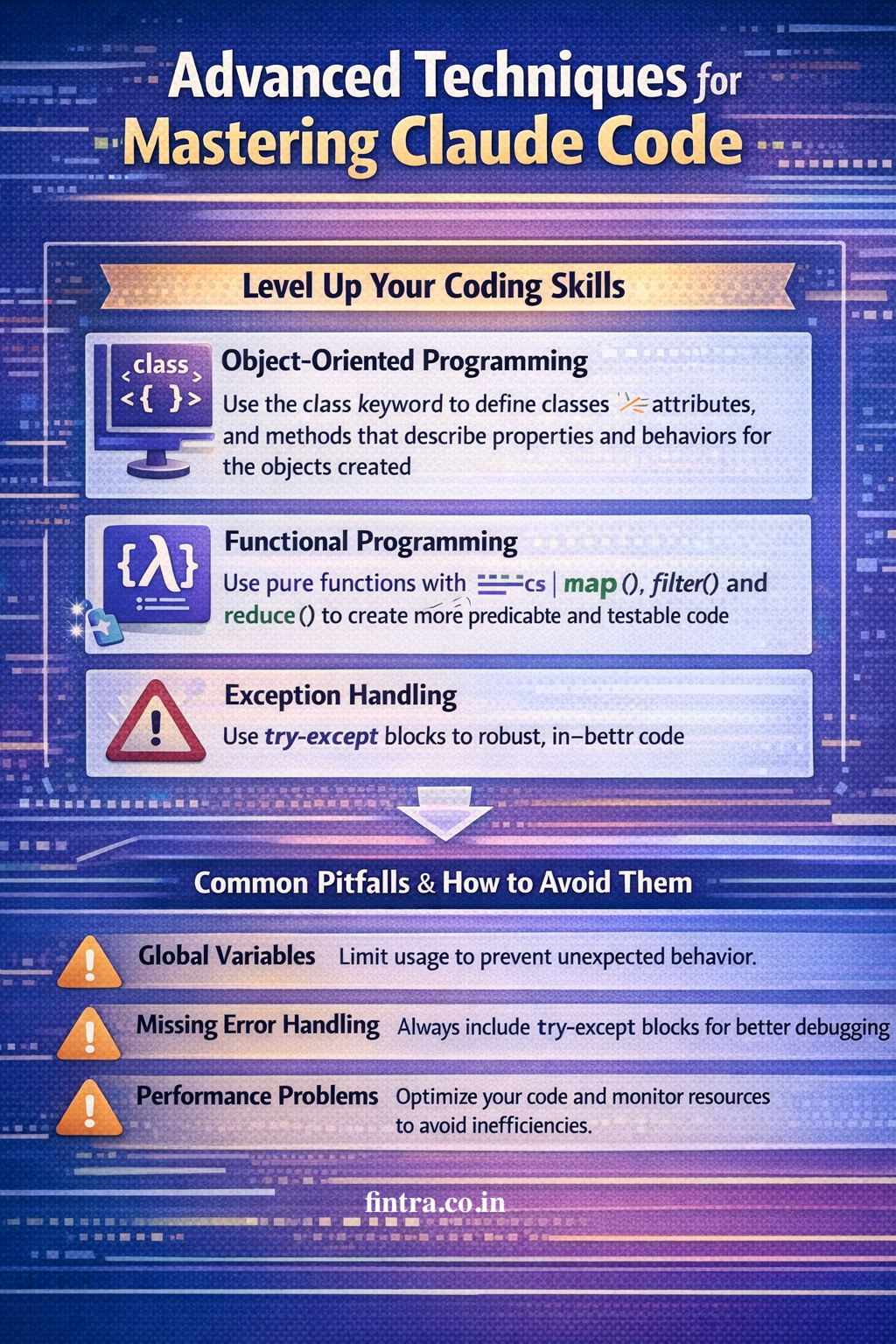
Once you're comfortable with the basics of Claude Code, it's time to explore more advanced techniques that can take your coding skills to the next level. One technique is object-oriented programming (OOP), which permits you to create and manage complex data structures using classes and objects. In Claude Code, you can define a class using the classkeyword, followed by the class name and a colon. Inside the class, you can define attributes and methods that describe the properties and behaviors of the objects created from the class.
Another powerful feature of Claude Code is its support for functional programming. This paradigm emphasizes the use of pure functions, immutability, and higher-order functions to create more predictable and testable code. Claude Code's standard library includes several built-in functions and modules that facilitate functional programming, such as map(), filter(), and reduce(). By incorporating functional programming techniques into your code, you can write more concise and expressive programs that are easier to reason about and maintain.
Exception handling is another advanced technique that can help you write more robust and resilient code. In Claude Code, you can use the try and except keywords to catch and handle exceptions that may occur during the execution of your program. This enables you to gracefully recover from errors and provide meaningful feedback to the user. Additionally, you can define custom exception classes to represent specific error conditions and raise exceptions using the raisekeyword. By mastering exception handling, you can build more reliable and user-friendly applications.
Common Pitfalls and How to Avoid Them
Even experienced developers can encounter pitfalls when working with Claude Code. One common issue is the misuse of global variables, which can lead to unexpected behavior and make your code harder to debug. To avoid this, it's best to limit the use of global variables and prefer local variables or function parameters whenever possible. If you need to use global variables, document their purpose and access them in a controlled manner.
Another common pitfall is neglecting proper error handling. Failing to anticipate and manage potential errors can result in crashes and unpredictable behavior, which can be frustrating for users and difficult to diagnose. Make it a habit to include error handling in your code, even for seemingly straightforward operations. Use try-except blocks to handle exceptions gracefully, return clear and informative error messages, and log errors to support effective debugging and application monitoring.
Performance issues can also be a challenge, especially when working with large datasets or complex algorithms. Inefficient code can lead to slow execution times and high resource consumption, which can degrade the user experience and limit the scalability of your application. To address this, always strive to write efficient and optimized code. Profile your code to identify bottlenecks, and use performance-enhancing techniques such as caching, memoization, and parallel processing where appropriate. Additionally, be mindful of the memory usage of your program and avoid unnecessary data copying and allocation.
Real-World Applications of Claude Code
Claude Code's versatility and power make it suitable for a wide range of real-world applications. One popular use case is web development, where Claude Code can be used to build dynamic and interactive websites. Frameworks like Flask and Django provide a robust foundation for developing web applications, offering features such as routing, templating, and database integration. With Claude Code, you can create everything from simple blogs to complex e-commerce platforms, all with clean and maintainable code.
Data analysis is another area where Claude Code excels. The language's extensive library ecosystem includes powerful tools for data manipulation, visualization, and statistical analysis. Libraries like Pandas, NumPy, and Matplotlib make it easy to work with large datasets, perform complex calculations, and create informative visualizations. Whether you're conducting scientific research, analyzing business data, or building machine learning models, Claude Code provides the tools and flexibility you need to gain valuable insights from your data.
Automation is yet another compelling application of Claude Code. With its simplicity and readability, Claude Code is an ideal choice for writing scripts to automate repetitive tasks and streamline workflows. From file management and system operations to web scraping and API integration, Claude Code efficiently supports a broad range of automation workflows. By automating mundane tasks, you can save time and reduce the risk of human error, allowing you to focus on more strategic and creative work.
Resources for Continued Learning and Support
Mastering Claude Code is an ongoing journey, and there are plenty of resources available to help you along the way. One of the best places to start is the official Claude Code documentation, which provides comprehensive and up-to-date information on the language's syntax, features, and standard library. The documentation includes tutorials, examples, and reference materials that can help you deepen your understanding of Claude Code and stay current with the latest developments.
Online courses and tutorials are another valuable resource for learning Claude Code. They offer a wide range of courses, from beginner to advanced levels, covering various aspects of Claude Code programming. Most of the time, these courses include video lectures, hands-on exercises, and quizzes to reinforce your learning. Additionally, many courses provide certificates of completion, which can be a valuable addition to your professional portfolio.
Community support also plays an essential role in the learning journey. Joining forums, discussion groups, and social media communities can provide you with opportunities to ask questions, share knowledge, and connect with other Claude Code enthusiasts. Websites are excellent places to find answers to your questions and collaborate on open-source projects. By engaging with the community, you can gain new perspectives, learn from others' experiences, and stay motivated on your path to mastery.
Conclusion and Next Steps
Unlocking the full potential of Claude Code requires dedication, practice, and a willingness to explore new concepts and techniques. By understanding the importance of learning Claude Code, familiarizing yourself with its key features, and setting up your development environment, you can lay a strong foundation for your coding journey. Mastering the essential syntax and commands, along with advanced techniques, will enable you to write efficient and maintainable code for a wide range of applications.
As you continue to develop your skills, be mindful of common pitfalls and seek out opportunities to apply your knowledge to real-world projects. Whether you're working on web development, data analysis, or automation, Claude Code offers the tools and flexibility you need to succeed. Take advantage of the many resources available for continued learning and support, and don't hesitate to reach out to the community for guidance and inspiration.
Your journey to mastering Claude Code is a rewarding one, filled with opportunities for growth and innovation. By staying curious, embracing challenges, and continuously expanding your knowledge, you can unlock new possibilities and achieve your goals. So, take the next step, dive into the world of Claude Code, and discover the endless potential that awaits you.